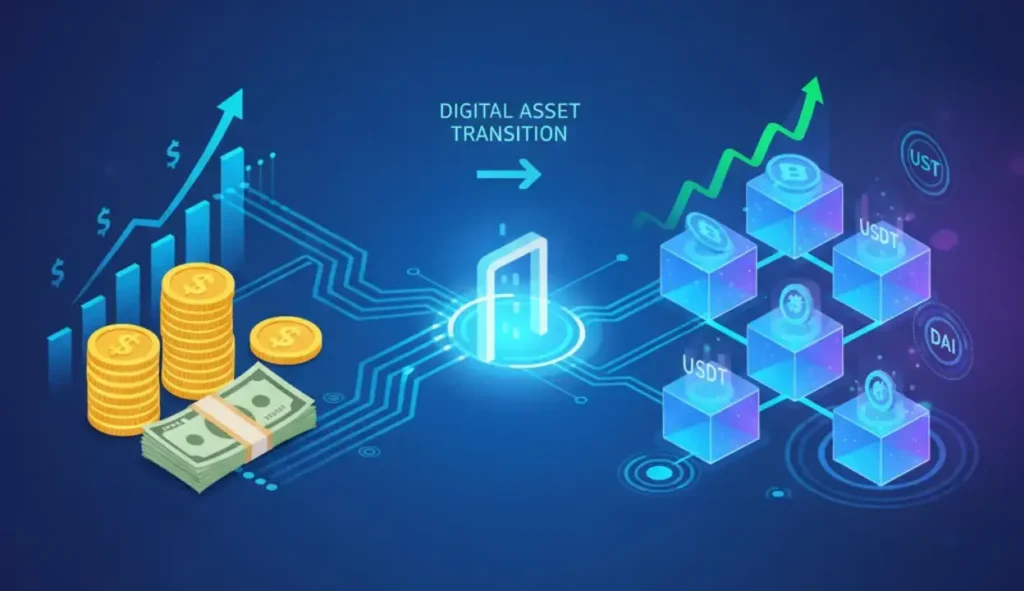
Complete migration from US financial markets to blockchain
The complete migration of US financial markets to blockchain involves digitizing and tokenizing traditional assets such as stocks and bonds to operate on secure blockchains.
This transition seeks a more efficient, transparent and accessible system where regulators and exchanges like Nasdaq promote the tokenization and digitalization of the stock market.
With political and financial support, the US financial network is transformed by integrating blockchain, reducing intermediaries and improving digital asset management.
Definition and meaning of blockchain migration in the US.
Migration to blockchain in the US is moving all financial operations to a decentralized infrastructure that records transactions immutably and securely.
It means a radical change in the financial structure, where assets are digitized and traded in the form of tokens under emerging regulatory frameworks.
Transformation in financial infrastructure: digitalization and tokenization
The financial infrastructure is modernized with digitalization and tokenization, optimizing payments and facilitating regulated digital assets in banking institutions.
Nasdaq and others use blockchain to streamline settlements, collateral mobility and global payments while regulators promote a secure environment.
Implications for transparency, security and accessibility
Migration to blockchain improves transparency thanks to immutable and accessible records that facilitate monitoring and reduce fraud.
In addition, it increases security with encryption and decentralization and improves accessibility by allowing assets to be divided, opening the investment to more participants.
Impact of the blockchain transition on the global financial system
The transition to blockchain in the global financial system improves operational efficiency and reduces costs by eliminating intermediaries. This increases the speed of transactions and reduces errors.
Blockchain offers greater security, transparency and decentralization, protecting funds and facilitating real-time auditing. Strengthens trust and regulatory compliance.
Decentralization facilitates financial inclusion and reduces geographic barriers, transforming asset management and banking operations worldwide.
Improvement in operational efficiency and cost reduction
Blockchain automates processes with smart contracts, reducing the need for manual reconciliation and the costs associated with intermediaries. This speeds up payments and settlements.
This technology reduces the risk of fraud and human error, and accelerates international payments, reducing commissions and settlement times.
Security, transparency and decentralization in finance
The cryptographic structure and distributed validation make blockchain highly secure, making manipulations and cyberattacks difficult in financial operations.
The public and immutable registry allows full visibility and auditability, facilitating regulatory compliance and increasing confidence in the financial system.
Asset tokenization and new investment opportunities
Tokenization converts real assets into digital tokens, enabling fractional ownership and facilitating accessible, liquid investments in digital markets.
Reduce costs and bureaucracy, and increase transparency and security, by recording all transactions on a decentralized blockchain.
Future innovations: CBDCs, stablecoins and decentralized finance (DeFi)
CBDCs modernize national payments and expand financial inclusion, offering government-backed digital currencies at lower cost and greater accessibility.
Stablecoins are growing as stable and fast digital currencies, crucial for global payments. DeFi powers new decentralized financial products and greater blockchain interoperability.
Role of stablecoins as USDT in the new digital economy
Stablecoins like USDT maintain a stable value when pegged to fiat currencies, reducing the volatility typical of other cryptocurrencies.
This real asset backup makes them a reliable means for digital payments and a key tool in the emerging digital economy.
They act as a bridge between traditional assets and the blockchain ecosystem, facilitating mass adoption of cryptocurrencies.
Stability and reduction of volatility compared to other cryptocurrencies
USDT and other stablecoins are backed by dollars or solid assets, allowing them to avoid large price fluctuations.
Thanks to this, they offer security and predictability in their values, being preferred for transactions and savings in cryptocurrencies.
Facilitation of fast and secure transactions
They operate on blockchain, allowing instant payments and irreversible confirmations without expensive intermediaries.
Its cryptographic structure guarantees security and transparency in each transaction carried out on the network.
Financial inclusion and backbone of digital payments
Stablecoins allow people without access to banks to participate in the digital economy through a telephone and the internet.
They are essential for global remittances and payments, reducing costs and times, especially in emerging economies.
Current opportunity to invest in cryptocurrencies according to experts
In 2025, experts see a strong opportunity to invest in cryptocurrencies, driven by institutional adoption and technological advances.
Clear regulation and growing institutional trust favor cryptocurrencies like Bitcoin, with expectations of strong increases.
Investing in companies linked to blockchain is also recommended to diversify and reduce portfolio volatility.
Factors driving valuation and adoption in 2025
The increased inflow of institutional funds increases demand, while regulatory frameworks such as MiCA encourage safe and sustainable investment.
Innovations in DeFi and ecosystems such as Ethereum promote new financial applications that contribute to the valorization of the sector.
Caution in the face of volatility and long-term prospects
Although increases are projected, volatility remains a significant risk, so it is advisable to diversify and manage risk with prudent strategies.
Cryptocurrency investments require long-term vision and a balanced approach to take advantage of trends without exposing yourself to sudden declines.
Western Union initiative with stablecoins and its impact on the digital economy
Western Union will launch USDPT, a backed and regulated stablecoin, using the Solana blockchain to make remittances faster and cheaper.
This initiative seeks to improve financial inclusion in inflationary economies, allowing easier access to stable digital assets.
In addition, it will integrate a network of more than 500,000 physical points to facilitate conversions between cash and stablecoins globally.