Relationship between productivity and economic growth
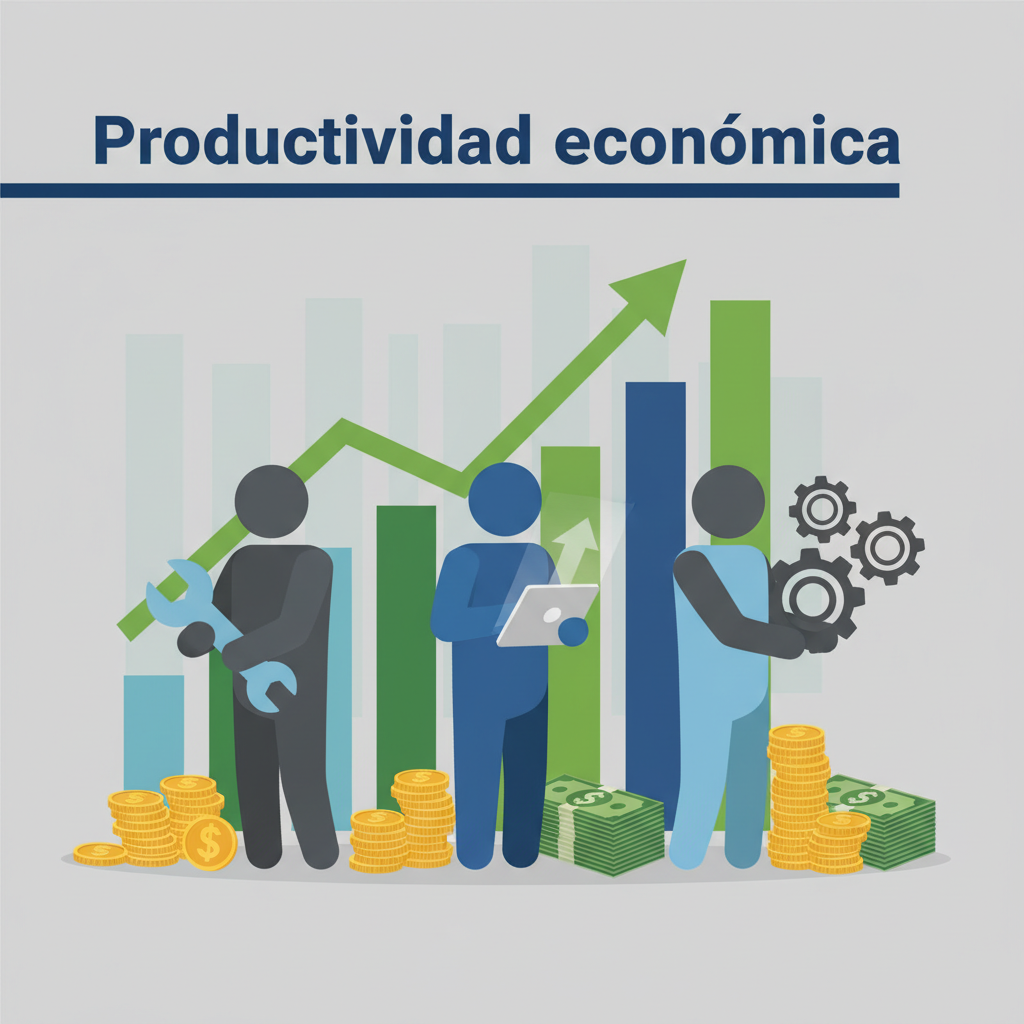
The economic productivity it is crucial for growth as it measures the amount of goods and services produced with available resources.
An increase in productivity means producing more with the same inputs, which drives efficiency and overall economic growth.
Definition and measurement of economic productivity
Economic productivity reflects the relationship between the production obtained and the resources used, such as labor and capital.
It is commonly measured as the product per hour worked or total production per unit of input, facilitating comparison over time.
This measurement allows the performance of companies, sectors and countries to be evaluated, and is essential to identify areas for improvement.
Impact of productivity on national efficiency and production
Improving productivity increases efficiency, allowing greater production with fewer resources, which increases national added value.
This increase in production generates more wealth for society and contributes to sustainable economic growth in the long term.
Furthermore, productivity determines the ability of an economy to improve wages and the general well-being of the population.
Factors that limit and promote economic growth
Economic growth may depend on increased employment or improvements in productivity, but sustained growth is based on productivity.
It is essential to understand what limits the increase in employment and how productivity, together with innovation, fosters real and lasting economic growth.
Limits on increasing employment as a way to growth
Growth based on increased employment alone is limited, as there are restrictions on the number of workable hours and available workers.
Job availability cannot expand indefinitely, and demographic or social factors can restrict the active workforce.
Furthermore, depending exclusively on employment does not improve efficiency, it only increases production at the cost of more resources used.
Improvements in labor productivity as the main driver
Sustainable economic growth depends on continuous improvements in productivity, which allow more to be produced with the same or fewer resources.
These improvements increase efficiency and competitiveness, generating greater national production and wealth that benefits the entire society.
Investing in training and process optimization is key to boosting productivity and consolidating economic growth.
Role of technological innovation and human capital
Technological innovation is a fundamental factor for productivity, allowing us to improve production methods and create new products and services.
Human capital, represented by the skills and knowledge of workers, is essential to adopt technologies and improve processes.
Investing in education and professional development strengthens both aspects, while boosting productivity and economic growth.
Importance of efficient infrastructure
Adequate infrastructure facilitates market access and reduces costs, supporting innovation and productivity, which is vital for economic development.
Link between productivity and salaries
The productivity it is a key factor that determines wage levels in an economy, since higher production per worker generates more resources.
When productivity increases, companies can pay better wages without losing competitiveness, directly benefiting workers.
How greater productivity allows for better wages
An improvement in productivity implies that workers generate more value with the same effort, which translates into greater income for companies.
With higher incomes, companies have the capacity to raise salaries, encouraging motivation and the quality of the work performed.
This positive cycle sustains economic growth based on efficiency and fair labor compensation.
Effects on purchasing power and social well-being
The increase in salaries derived from productivity improves the purchasing power of workers, allowing greater consumption and quality of life.
Furthermore, higher salaries contribute to a better distribution of income and enhance the general social well-being of the population.
This creates a virtuous circle where the economy grows and sustainably improves everyone's standard of living.
Differences between economies according to their productivity
Economies are significantly distinguished by their levels of economic productivity, which impacts their growth and social well-being.
Countries with high productivity tend to enjoy better wages, higher per capita incomes, and higher standards of living.
Characteristics of countries with high productivity
Countries with high productivity have advanced infrastructure, constant technological innovation and qualified human capital.
These economies efficiently take advantage of their resources, resulting in greater production and global competitiveness.
In addition, they foster an environment conducive to investment and maintain educational systems that enhance work skills.
Challenges of economies with low productivity
Economies with low productivity face limitations in growing, since their workers produce less with equal or greater inputs.
This negatively affects wages, generates lower purchasing power and restricts sustainable social and economic development.
They frequently lack technological innovation, investment in human capital and adequate infrastructure, which slows their progress.