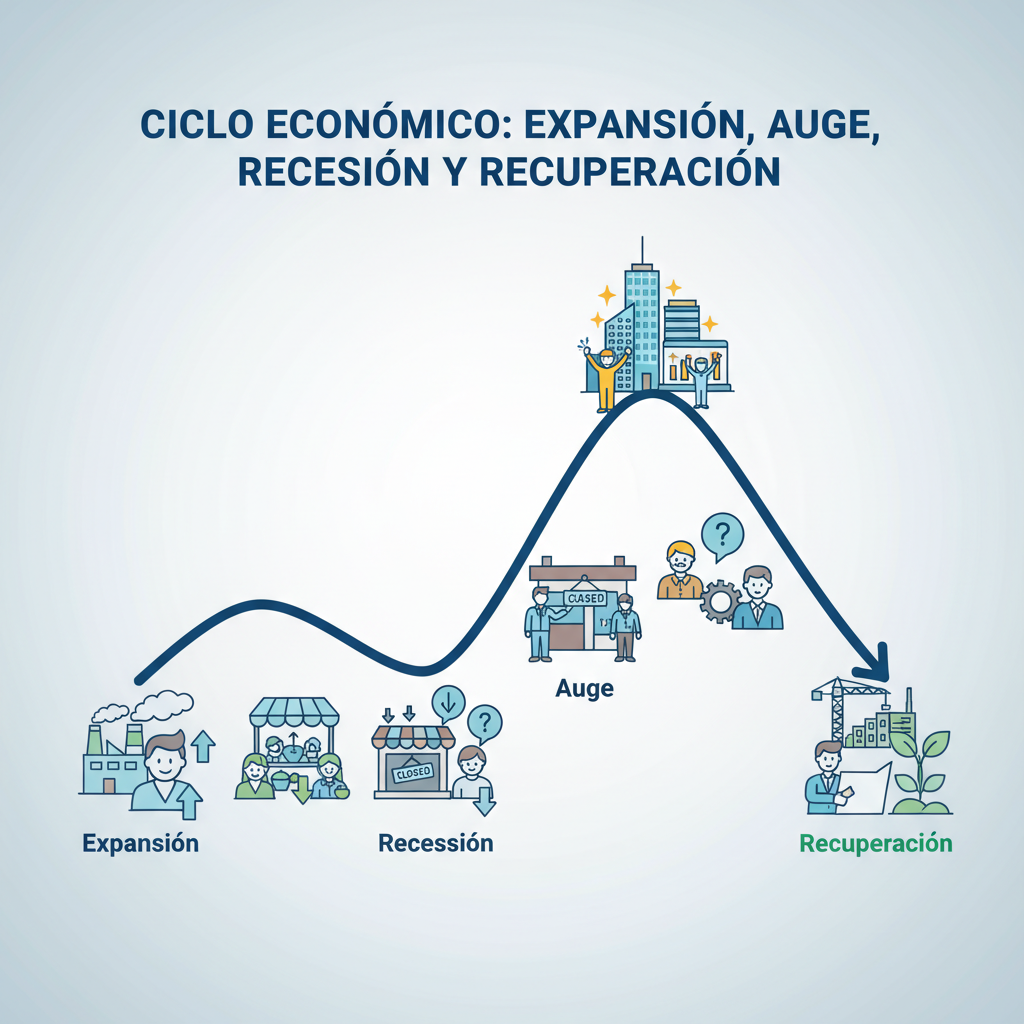
Phases of the economic cycle
The business cycle consists of four essential phases that reflect the dynamics of an economy over time. These phases indicate increases and falls in economic activity.
Fluctuations in the economy affect production, employment and investment, and although their phases are recurrences, they do not always have the same duration or intensity.
Expansion and recovery
Expansion or recovery begins the upward cycle after a period of crisis or stagnation. During this stage, the economy shows clear signs of improvement.
Production and employment increase, as well as consumption and investment. The Gross Domestic Product (GDP) begins to grow, generating general optimism.
This optimism drives economic activity, strengthening consumer and business confidence, paving the way for the next phase.
Boom
The boom is the peak of the economic cycle where the economy operates at full capacity. Employment and production reach historic levels.
However, in this phase imbalances such as overproduction and inflationary pressures may arise due to market saturation.
The economy can “reheat”, generating bubbles that announce the end of the boom and, therefore, the transition to recession.
Characteristics of each phase
Each phase of the economic cycle presents specific characteristics that determine the behavior of the economy. These differences affect production, employment and general stability.
Understanding these features is essential to anticipate economic changes and apply appropriate policies that seek to stabilize or enhance growth.
Signs and dynamics of expansion
During expansion, the economy experiences a steady increase in production and employment, driven by renewed consumer and business confidence.
Consumption and investment grow simultaneously, which strengthens demand and facilitates the generation of new jobs, energizing the internal market.
This phase is characterized by a positive GDP trend, as well as general optimism that stimulates innovation and business expansion.
Problems during the boom
In the boom phase, the economy operates at its maximum capacity, which can cause market saturation and creation of productive excesses.
Inflationary pressures often increase as demand exceeds supply, and this imbalance can lead to dangerous economic bubbles.
These problems herald the end of expansion and the beginning of a contraction, putting economic stability at risk.
Effects of the recession
The recession is identified by a drop in production, investment and employment, which reduces the well-being and confidence of consumers and businesses.
This phase can be brief or prolonged and, in severe cases, leads to depression with high levels of unemployment and lower prices.
The decline affects both supply and demand, deepening the contraction and affecting multiple economic sectors.
Recovery process
The recovery occurs when the economy begins to overcome the negative effects of the recession and shows signs of gradual growth.
Investment improves and consumption is reactivated, leading to a sustained increase in GDP and the progressive creation of new jobs.
This process once again prepares the return to expansion, completing the economic cycle and promoting future stability.
Economic and social impacts
Fluctuations in the business cycle cause significant impacts on society and the economy. These effects vary depending on the phase, affecting general well-being.
Periods of recession and depression often generate economic and social tensions that require attention to mitigate their negative consequences.
Consequences of recessions and depressions
Recessions are characterized by a drop in production, investment and employment, which increases unemployment and reduces disposable income.
During depression, these effects worsen, generating poverty, lower consumption and difficulties for companies and households in maintaining their activity.
The contraction affects consumer and business confidence, causing a prolonged decline in demand and slowing the economic recovery.
Importance of economic stability
Economic stability is crucial to avoid extreme fluctuations that negatively affect the population and sustainable development of a country.
Appropriate policies and social protection mechanisms help mitigate the impact of crises, promoting balanced growth and reduction of inequalities.
A stable environment encourages investment, employment and trust, creating favorable conditions for long-term collective prosperity and well-being.
Management and economic policies
Economic management seeks to reduce the negative impacts of cyclical fluctuations to ensure sustained growth. Stabilizing policies act as key tools.
Implementing these policies is essential to mitigate deep crises, encourage investment, and maintain acceptable levels of employment and production over time.
Need for stabilizing policies
Stabilizing policies seek to smooth out the extreme phases of the economic cycle, avoiding deep and prolonged recessions that damage the economy and social well-being.
These measures include fiscal and monetary interventions that regulate consumption, investment and credit to balance the economy in times of excess or crisis.
Without these policies, fluctuations can intensify, prolonging critical periods and hindering economic recovery.
Role of self-regulation in market economies
Self-regulation allows the market to correct imbalances through changes in prices, wages and investments, favoring natural adaptation to variations.
However, self-regulation does not always act quickly or efficiently, which justifies state intervention to avoid serious social impacts.
The combination of self-regulation with appropriate public policies contributes to a more resilient and balanced economy.