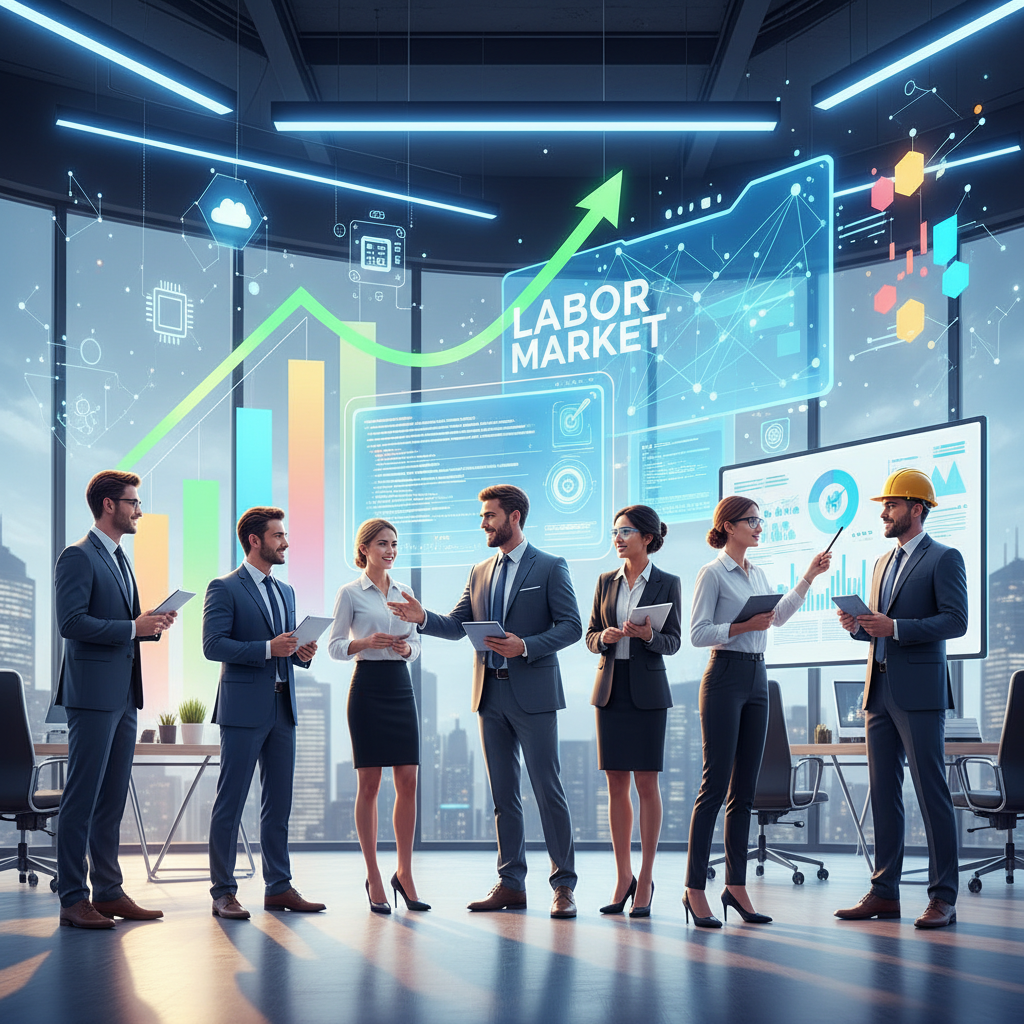
Transformation of the labor market in Spain
The Spanish labor market is undergoing a profound transformation driven by technology and digitalization. These trends redefine employment demands and open new opportunities.
Moderate growth in employment is observed, with special interest in technological sectors. This requires trained professionals to face these current challenges.
Growing sectors and technological demands
The information technology, software development and cybersecurity sectors are the most dynamic currently. These fields show a boom due to the growing need for innovation.
Digitalization drives the demand for experts in advanced technologies, making companies look for highly qualified talent adaptable to permanent technological changes.
The growth of these sectors reflects the importance of investing in specialized training to take advantage of the job opportunities that arise in Spain.
Changes in professional profiles due to AI and automation
Artificial intelligence and automation are transforming professional profiles, raising demand for AI engineers, data analysts and cybersecurity specialists.
These technological advances require specific technical skills and constant updating to maintain competitiveness in the labor market.
Furthermore, workers must develop transversal skills that complement technology, thus guaranteeing effective integration into new work environments.
Role of vocational training in employability
Vocational training is positioned as a key element to improve employability in a constantly changing labor market. Medium and high qualifications are increasingly in demand.
Adapting to new technologies and current employment requirements requires continuing education. Therefore, vocational training is essential to keep pace with work evolution.
Importance of medium and high qualification training
Medium and high-skilled training is essential to respond to market demands. Employers look for professionals with solid technical knowledge and up-to-date skills.
This type of training facilitates job placement and improves the ability to adapt to new functions, especially in technological and expanding sectors.
Furthermore, proper preparation reduces the existing skills gap and contributes to greater stability and professional growth.
Dual programs and lifelong learning
Dual programs combine theoretical training with paid internships, providing real experience and facilitating the transition to employment.
This modality is especially useful for young people, as it offers them comprehensive training that responds to the real needs of the market.
On the other hand, lifelong learning allows senior professionals to update their skills, guaranteeing their employability over time.
Updating skills for senior professionals
Senior professionals need to update their skills to remain competitive in a rapidly evolving market.
Continuous and specialized training allows them to adapt to new technologies and methodologies, maintaining their professional value.
This update is vital to avoid obsolescence and promote a longer and more productive working life, benefiting both companies and employees.
New modalities and work experiences
Teleworking and work flexibility have become essential elements of the labor market, especially in large cities where the pace of life is fast.
These modalities not only increase productivity but also allow a better balance between personal and professional life, valued by workers.
Likewise, companies are committed to designing attractive job benefits that strengthen their employer brand and help retain talent in a competitive environment.
Teleworking and labor flexibility in large cities
In cities such as Madrid, Barcelona and Valencia, teleworking is already a common practice that improves the quality of life of employees, reducing travel and costs.
Flexibility in schedules and the hybrid work option allow adaptation to individual needs, increasing job satisfaction and commitment.
These new work dynamics respond to the demand for more human environments adapted to personal circumstances, promoting a cultural change in companies.
Job benefits and construction of the employer brand
Offering benefits such as health insurance, continuing education and wellness programs has become essential to attract and maintain talent in organizations.
The construction of the employer brand is strengthened through transparent communication on social networks, showing values and business culture that connect with candidates.
Agile and gamified selection processes not only improve the candidate experience, but also contribute to positively positioning the corporate image.
Challenges and opportunities of the labor market in 2025
In 2025, the labor market faces significant challenges linked to labor cost and the new policies to reduce working hours, affecting competitiveness and work organization.
At the same time, opportunities grow with the green transition and the focus on sustainable development that generates jobs in innovative and environmentally friendly sectors.
Impact of labor costs and reduction of working hours
The increase in labor costs and the reduction of the working day to 37.5 hours seek to improve the quality of life, but represent a challenge for business productivity and profitability.
This measure drives the need to optimize resources and promote digitalization to maintain competitiveness in the face of higher costs and organizational adjustments.
Lower-skilled sectors are especially affected, increasing the importance of training to increase efficiency and adapt to these changes.
Green transition and sustainable growth
The transition towards a greener economy opens new opportunities in renewable energy, electric mobility and environmental management, sectors with high demand for specialized talent.
This sustainable approach not only contributes to the protection of the planet, but also drives economic growth based on innovation and stable employment.
Companies and workers must adapt to these new trends, developing skills that favor circular economy and responsible practices.