Definition and concept of GDP
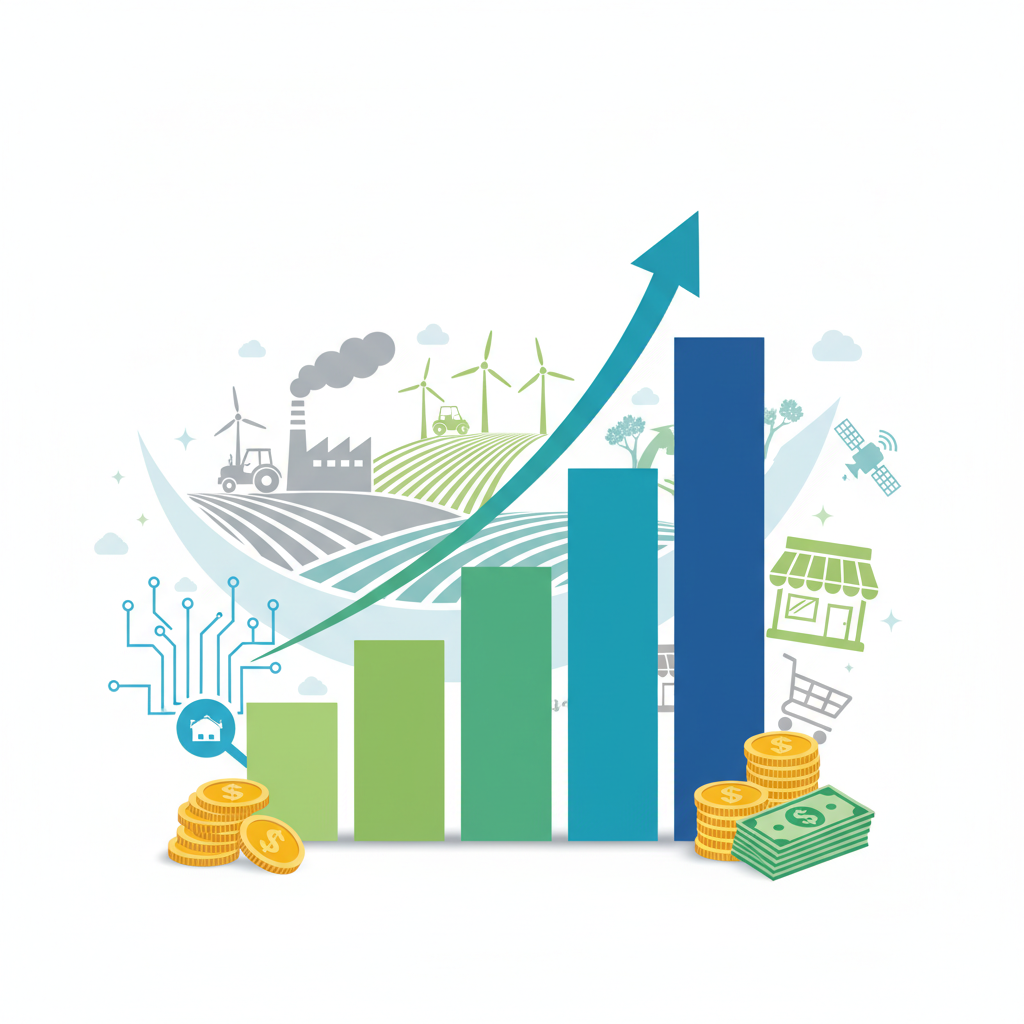
The Gross Domestic Product (GDP) it represents the total monetary value of final goods and services produced in a country during a specific period.
This macroeconomic indicator reflects the wealth generated in an economy and is key to evaluating its size and overall economic health.
GDP is used to measure national production and serves as a basis for comparing economic growth over time and between different nations.
What is the Gross Domestic Product
GDP measures the value of all goods and services produced within a country in a given time, usually a year or quarter.
It is considered a fundamental indicator to understand the economic activity and the level of production that a territory generates.
This indicator helps identify whether an economy is growing, remaining stable or entering recession, thus reflecting economic dynamics.
In addition, it allows productive capacity to be evaluated and compared with other countries or periods, being crucial for economic planning.
How GDP is calculated
GDP can be calculated by adding the market value of all final goods and services produced in the country during the evaluated period.
The production of goods and services is considered, excluding intermediate ones to avoid double counting and guarantee precision.
There are three main methods for calculating GDP: the spending approach, the production approach, and the income approach, each with its own perspective.
Interesting fact
The spending approach is the most common and includes consumption, investment, public spending and net exports as key components of GDP.
Importance of GDP for the economy
The Gross Domestic Product it is essential to understand the economic health of a country and its capacity for growth. Its evolution indicates changes in national production and wealth.
This indicator serves as a basis for making decisions in various sectors, from public policies to business strategies, allowing the general economic situation to be evaluated.
By analyzing GDP, governments and analysts can interpret economic dynamism, anticipate problems and design plans that promote sustainable development.
Economic growth indicator
GDP reflects whether the economy is growing or contracting. An increase in this value indicates greater production and productive activity in the country.
When GDP grows, there is usually an increase in investment, consumption and job creation, which promotes a positive and stable economic cycle.
On the contrary, a fall in GDP can anticipate periods of recession, where economic activity decreases and job opportunities are reduced.
Relationship with employment and consumption
GDP growth is directly linked to job creation, since greater production requires more labor and human resources.
Likewise, rising GDP typically drives the consumption of goods and services, as people have greater purchasing power and economic confidence.
Therefore, GDP is a reflection of the material well-being and standard of living of the population, although it does not consider other social factors.
Use in economic policies
Governments use GDP to design economic policies that promote growth, stability and sustainable development in the country.
This indicator helps plan public spending, taxes and measures to incentivize productive sectors and regulate the economy as necessary.
GDP also guides decisions about foreign investment and social programs, seeking to balance growth with social and environmental well-being.
GDP limitations as an indicator
GDP, although important, does not fully reflect social well-being or the ecological impact of economic activity.
This monetary indicator excludes relevant aspects such as quality of life, inequality and environmental damage, limiting its global vision.
Therefore, it is necessary to complement GDP with other indices to better understand the social and environmental reality of a country.
Unreflected social and ecological aspects
GDP does not measure social factors such as income distribution, citizen well-being or quality of life of the population.
Nor does it account for the negative environmental impact generated by production, such as pollution or depletion of natural resources.
This means that serious problems can be hidden despite economic growth, affecting long-term sustainability.
Thus, an increase in GDP does not guarantee improvements in social equity or environmental conservation.
Informal economy and its absence in calculation
The informal economy, which includes activities not officially registered, is excluded from the GDP calculation.
In many countries, this economy represents a significant part of employment and production, without being reflected in official statistics.
Its omission distorts economic reality and makes it difficult to design effective policies for all social sectors.
Practical applications of GDP
The GDP it is an essential tool to compare the economic performance of different countries, allowing their size and level of development to be evaluated.
It also facilitates the analysis of economic evolution over time, identifying growth or contraction trends between different periods.
This comparison is crucial to understanding global and regional dynamics, and making informed decisions in public and private settings.
Comparison between economies and periods
Comparing GDP between countries helps identify which economies are larger or growing faster, guiding investments and policies.
By analyzing different periods, the impact of crises, reforms or economic policies on national production and well-being can be measured.
In addition, it allows adjusting economic strategies to improve the competitiveness and international positioning of a country or region.
Design of development and investment strategies
GDP analysis is key to designing development plans that promote productive sectors with greater growth potential.
Based on this data, governments and companies can decide where and how to invest to maximize economic and social impact.
Likewise, GDP guides the efficient allocation of resources to promote employment, innovation and improve the quality of life.