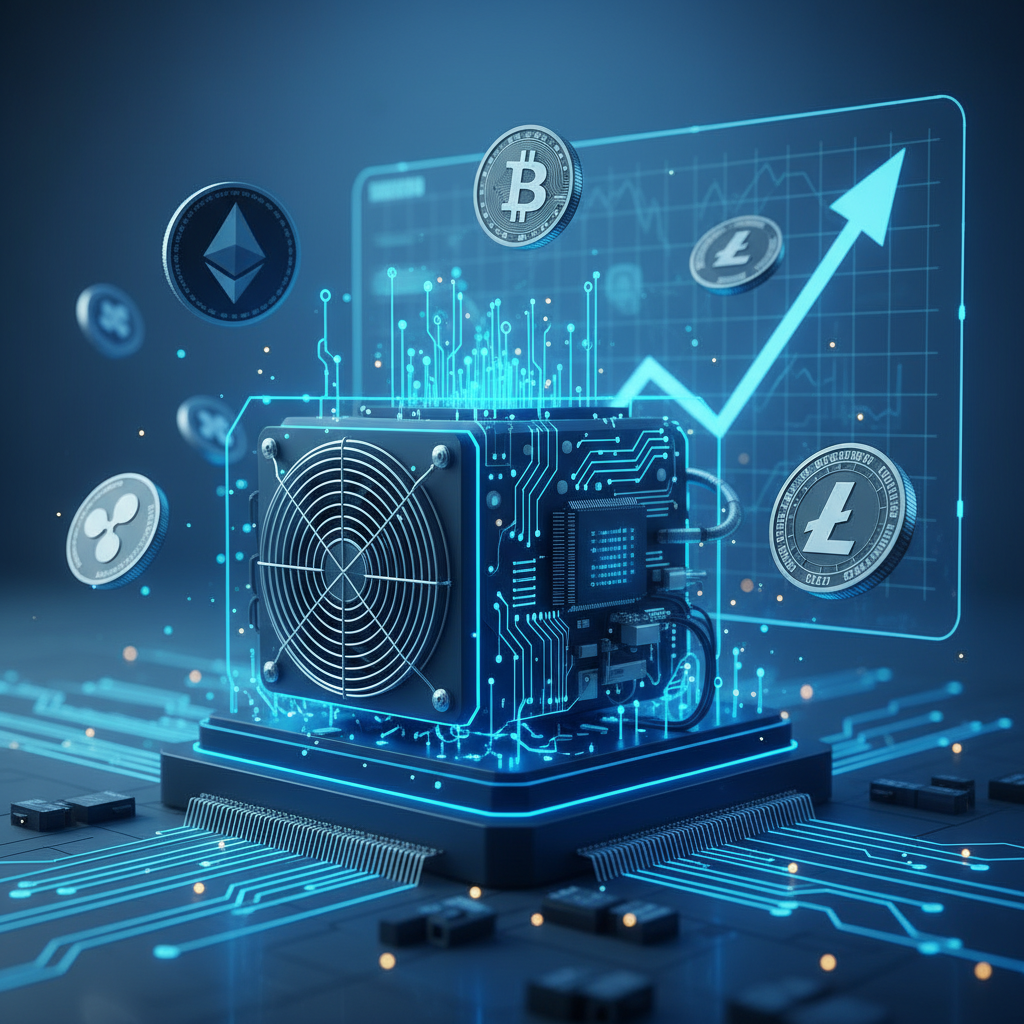
Basic concepts of cryptocurrency mining
The cryptocurrency mining it is the process in which transactions are validated and recorded on a blockchain using specialized computers. This procedure secures the network and maintains its decentralization.
Miners compete to add new blocks by solving complex mathematical problems, receiving cryptocurrency rewards and commissions for each validated transaction. It is a fundamental activity for the operation of blockchains.
This process requires powerful hardware and consumes energy, making mining a technical activity with important economic considerations for those who want to participate.
Definition and function of mining in the blockchain
Mining is the function that allows transactions to be secured and validated within a blockchain network. By using computing power, miners verify the veracity of each transaction.
Additionally, mining links blocks on the chain, ensuring the immutability and reliability of transaction history for all network participants.
Thus, miners guarantee security, avoid fraud and maintain the integrity of the decentralized system, being rewarded for this work with new currencies and commissions.
Tools and technology used in the process
Specialized devices such as ASICs in Bitcoin, designed to optimize the mining process, or GPUs for other cryptocurrencies that are more flexible in hardware.
These equipment must be capable of solving extremely complex mathematical calculations and demand high energy consumption, so their efficiency is key to profitability.
In addition, software and monitoring systems are used to optimize machine performance and manage costs, seeking to maximize profits in a competitive environment.
Factors affecting profitability in 2025
Mining profitability in 2025 is influenced by several key factors that determine whether or not this activity will remain profitable for miners.
Understanding these elements is essential for those who wish to invest in equipment or continue mining as they directly affect net profits.
These factors include both economic and technical aspects that interact in a competitive and technological environment.
Impact of mining price and difficulty
The price of cryptocurrency is one of the most critical elements that affects profitability. At higher prices, profits tend to increase for miners.
Mining difficulty, which automatically adjusts based on the network, increases with the number of miners and computing power, increasing the effort required and reducing the relative reward.
Therefore, an increase in difficulty can reduce profitability if costs remain the same and the price of the currency does not rise proportionally.
Electrical costs and equipment maintenance
Electricity costs are a significant percentage of total mining spending due to the high energy consumption of specialized equipment such as ASICs or GPUs.
Maintaining optimized equipment in good condition also involves maintenance, repair and replacement of parts, which directly impacts final profitability.
Access to cheap energy and efficient technologies is crucial to maximizing profits and competing in a market where margins can be tight.
Key events such as halving and protocol changes
Halving, an event that halves the reward per mined block, occurs periodically and decreases economic incentives for miners, affecting their income.
Protocol changes, such as Ethereum's transition to a staking validation system, also modulate the viability of traditional mining, limiting its profitability in certain cryptocurrencies.
These events force miners to adapt by adopting new technologies or focusing on currencies that keep mining as the basis of their safety and operation.
Alternatives and current trends in cryptomining
Currently, cryptomining evolves with alternatives that seek to reduce energy consumption and improve efficiency. This includes new ways to validate transactions.
The traditional proof-of-work (PoW) mining system is being questioned by more sustainable methods such as staking, which changes the way the network is secured.
Staking validation systems vs traditional mining
Traditional mining uses computational power to solve complex calculations, consuming a lot of energy and requiring specialized hardware. This impacts costs and ecology.
On the other hand, staking proposes a model where validators must own and block cryptocurrencies to participate in validation, reducing the need for powerful hardware.
Staking consumes less power, is more accessible to users with less initial investment, and can offer similar rewards, driving its adoption across multiple networks.
This trend reflects a shift towards a greener, more decentralized ecosystem, where security is maintained without the high energy cost of traditional mining.
Considerations for deciding whether to mine today
Before starting mining, it is vital to evaluate the technical requirements necessary to ensure efficient and profitable operation. Adequate infrastructure is essential.
Choosing the right equipment, access to affordable energy, and a location with adequate ventilation and space make all the difference in mining success.
In addition, having a good internet connection and security against cyber threats is essential to protect the investment and maintain the continuity of the process.
Technical requirements and necessary infrastructure
Mining requires specialized devices such as ASICs or powerful GPUs, which must be correctly installed and configured to optimize their performance.
A stable and economical electricity supply is critical, as energy costs are one of the largest expenses in mining.
It is also essential to have an efficient cooling system to avoid overheating and prolong the useful life of the equipment.
The dedicated space must be safe, with good ventilation and protection against electrical or environmental failures to ensure process stability.
Cost, efficiency and market analysis
A detailed calculation of initial costs, including hardware, installation and power, is necessary against the possible profits that will be obtained.
The efficiency of mining equipment directly influences profitability, as it maximizes production and minimizes energy consumption and associated expenses.
The cryptocurrency market is volatile, so price fluctuations affect profits; Therefore, analyzing trends is key to deciding whether to mine or not.
Finally, evaluating the time to return on investment helps to know if mining is viable under current and projected market conditions.